
Social Media Account Transaction Fraud: Myth-Busting the Middleman Service
You don't own a digital asset just because you have the login credentials. In the high-stakes world of account flipping, a seller can reclaim a YouTube or Instagram channel days after you've sent the crypto; this leaves you with an empty wallet and zero recourse. This reality is the primary driver behind the surge in social media account transaction fraud, where sophisticated actors exploit the technical gap between payment and permanent ownership transfer.
It's natural to feel anxious when sending significant capital to an anonymous entity. You're right to worry about pullback scams or getting your new asset flagged for suspicious activity during a clumsy handover. We understand that security isn't a luxury. It's the foundation of your investment. You can eliminate these risks by moving away from dangerous handshake deals and toward a structured, milestone-based workflow. This guide breaks down the specific red flags of account fraud and explains why a professional middleman service is the only infrastructure capable of securing a high-risk digital handover. You'll learn how to identify sophisticated schemes and implement a fraud-proof method for transferring your next digital asset with total peace of mind.
Key Takeaways
- Understand why login credentials don't equal permanent ownership and how the recovery email loophole leads to immediate asset loss.
- Identify the red flags of social media account transaction fraud, including high-pressure sales tactics and a refusal to use secure handover services.
- Learn the difference between basic escrow and a specialized middleman service that verifies platform-specific security like 2FA and manager roles.
- Use a milestone-based transaction workflow to ensure funds are only released after the asset is fully secured and verified.
- Build a safer investment strategy by leveraging manual listing reviews and identity-verified marketplaces for high-risk digital assets.
Table of Contents
- The Reality of Social Media Account Transaction Fraud in 2026
- 5 Dangerous Myths About Buying and Selling Social Assets
- Why a Standard Escrow Isn't a True Social Media Account Middleman Service
- Spotting the Scam: Red Flags in Digital Asset Handovers
- AccsMarkets: Securing Transactions Through Milestone-Based Protection
The Reality of Social Media Account Transaction Fraud in 2026
Social media account transaction fraud is the intentional deception during the purchase or sale of digital assets. It isn't a simple misunderstanding or a "bad deal." It's a calculated attempt to steal capital or high-value accounts through technical loopholes. In 2026, platforms are more vulnerable than ever. Automated recovery systems, while helpful for legitimate users, are now weaponized by malicious sellers. They use "original owner" signals to trigger instant account pullbacks minutes after a buyer sends payment. This exploit makes direct peer-to-peer transfers nearly impossible to secure without professional intervention.
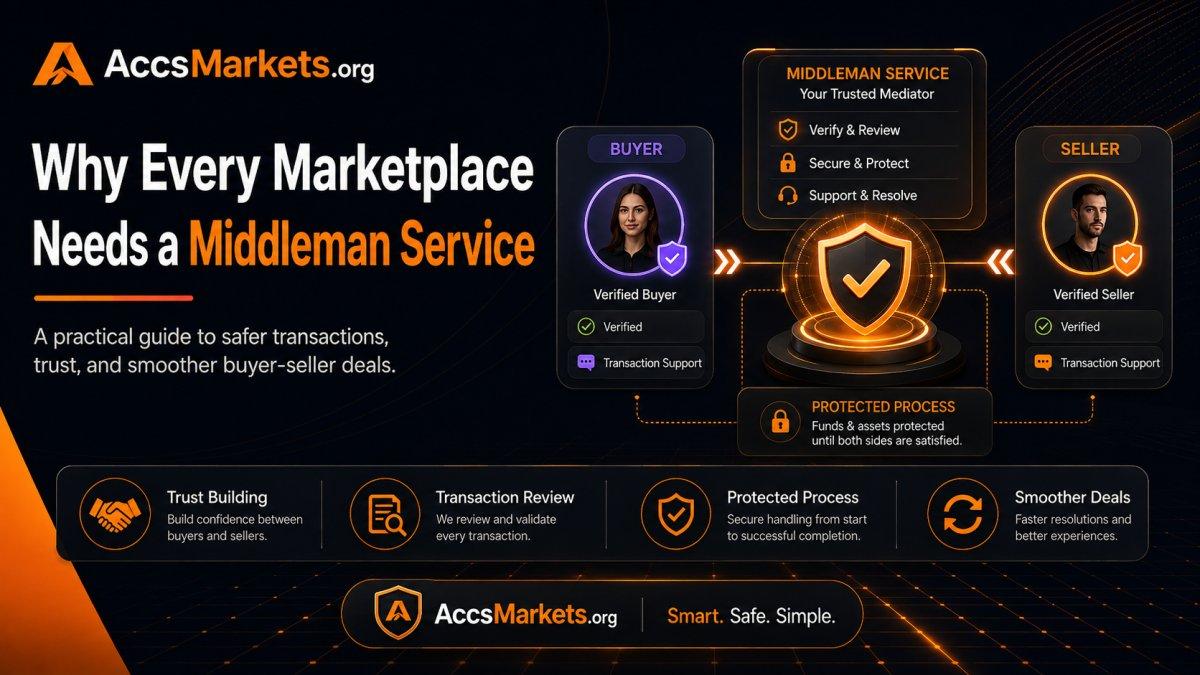
The primary targets remain high-liquidity assets. Monetized YouTube channels, high-follower Instagram accounts, and TikTok profiles are the top priorities for scammers. These assets represent significant time and financial investment. A professional middleman service acts as the only real defense. It functions as a neutral intermediary, holding funds and verifying the handover before any capital moves. It provides the risk-mitigation infrastructure that social media platforms refuse to build themselves.
Why Traditional Fraud Protection Fails
Standard payment protections aren't built for digital asset transfers. PayPal "Goods and Services" offers almost no protection for intangible items. Scammers know how to manipulate the dispute process to ensure they keep the money and the account. Bank wires are just as risky in anonymous P2P transactions. There's no "undo" button for a wire transfer once it hits a scammer's offshore account. Many social media account transaction fraud schemes also rely on the "no refund" nature of cryptocurrency. Scammers demand crypto because it eliminates the buyer's ability to initiate a chargeback, leaving the victim with zero recourse.
The Rise of Professional Digital Asset Scammers
Scammers now operate with high levels of sophistication. They often pose as "fake agencies" to project an image of professional reliability. These groups use forged analytics and deepfake verification videos to inflate the perceived value of an asset. This creates a dangerous Trust Gap. The Trust Gap is the fundamental lack of verifiable security in direct peer-to-peer digital marketplaces. Many of these actors also engage in activities related to what is identity theft to impersonate legitimate sellers. They use stolen credentials and high-trust forum profiles to lure in unsuspecting buyers. You aren't just dealing with a dishonest individual; you're dealing with a professional operation designed to bypass your security checks.
5 Dangerous Myths About Buying and Selling Social Assets
Assumptions are expensive in the digital asset market. Many buyers enter transactions believing that basic security habits will protect them. They don't. Scammers rely on these common misconceptions to facilitate social media account transaction fraud. If you want to protect your capital, you must stop believing these five dangerous myths.
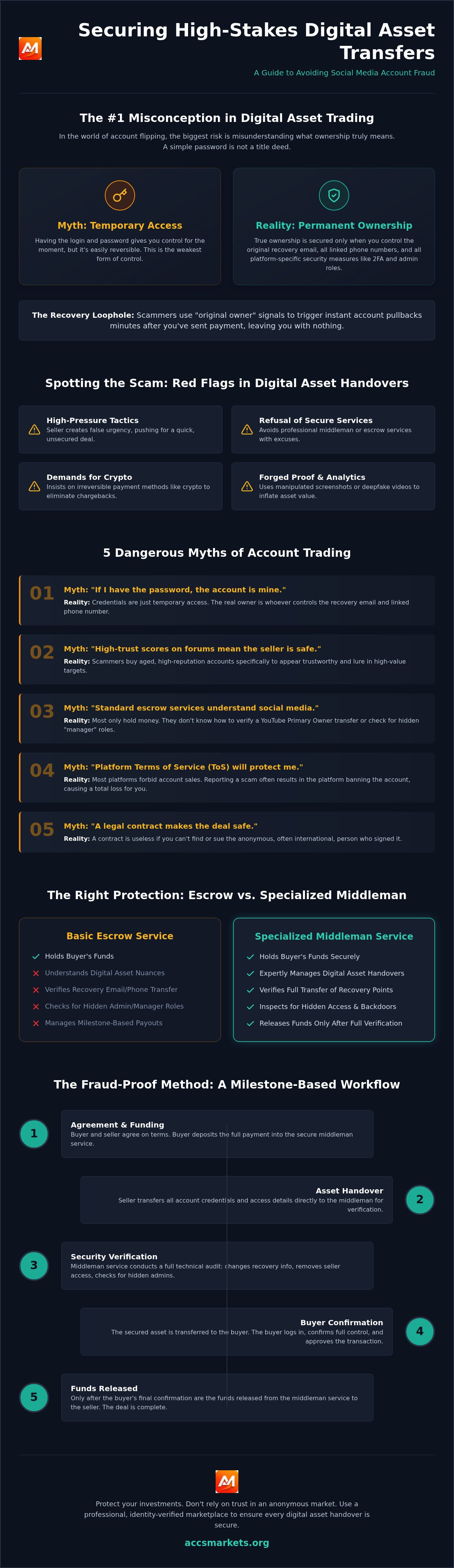
- Myth 1: "If I have the password, the account is mine." Credentials are just temporary access. The real owner is whoever controls the recovery email and linked phone number.
- Myth 2: "High-trust scores on forums mean the seller is safe." Reputation is a commodity. Scammers buy aged accounts with high feedback scores specifically to lure in high-value targets.
- Myth 3: "Standard escrow services understand social media handovers." Most escrow providers only hold money. They don't know how to verify a YouTube Primary Owner transfer or check for hidden "manager" roles.
- Myth 4: "Platform Terms of Service (ToS) will protect me." Most platforms forbid account selling. If you report a scam, the platform will simply ban the account, leaving you with no asset and no refund.
- Myth 5: "I can safely transfer an account with a contract." A contract is only as good as your ability to find and sue the person who signed it. In a world of anonymous crypto and cross-border deals, paper promises are often worthless.
The FTC report on social media scams confirms that fraud is reaching record highs. You need technical barriers, not just good intentions. Smart buyers use a verified marketplace to handle the technical heavy lifting of security verification.
The "Pullback" Scam: The Industry's Dirty Secret
The pullback is the most common form of social media account transaction fraud. A seller provides the correct login details and waits for the buyer to release the funds. Once the money is gone, the seller uses the "Original Email" (OGE) to tell the platform the account was hacked. Because platforms prioritize the creator's original data, the account is returned to the scammer within hours. This trap works because the buyer didn't realize that simply changing the password doesn't remove the seller's underlying recovery rights. Using a secure account handover service is the only way to ensure these recovery vectors are permanently closed before you pay.
Why Contracts are Often Enforceable Only in Theory
Legal recourse is a myth for most small to mid-sized digital transactions. If you are in the United States and the seller is in Eastern Europe or Southeast Asia, filing a lawsuit is financially impossible. Anonymity in cryptocurrency further complicates the issue. You cannot serve papers to a wallet address. This is why platform-controlled workflows must replace "paper" promises. A technical workflow that forces a staged transfer is far superior to a legal document you can't enforce. You need a system that prevents the crime from happening, rather than a contract that tries to fix it after the fact.
Why a Standard Escrow Isn't a True Social Media Account Middleman Service
Generic escrow is a blunt instrument. It solves the payment problem but ignores the asset problem. In the context of social media account transaction fraud, simply holding funds is insufficient. You need a partner who understands that a YouTube channel transfer takes seven days to finalize a primary owner change. A standard service might release funds as soon as you get a password; this leaves you vulnerable to a pullback before the transfer is technically complete on the platform level. This gap in knowledge is exactly where scammers operate.
A specialized middleman manages platform-specific nuances. They verify 2FA settings, check for hidden "manager" permissions, and ensure the original recovery email is truly disconnected. This granular oversight prevents "shadow" access where a seller retains control despite giving you the keys. They also mitigate IP flagging risks. Rapidly changing security details from a new location often triggers automated platform bans. A professional service provides the workflow to navigate these security hurdles safely, ensuring the asset remains healthy during the transition.
The Milestone-Based Workflow Advantage
Security happens in stages. It isn't a single event. A professional workflow breaks the transaction into logical checkpoints to ensure fairness for both parties. This structured approach eliminates the "all-or-nothing" risk of traditional P2P deals.
- Step 1: Verification of ownership and analytics. The seller must prove they control the asset and that the engagement data is authentic before any money moves.
- Step 2: Secured payment through approved providers. Funds are held by trusted third-party providers, ensuring they're available but not yet accessible to the seller.
- Step 3: Staged credential handover. The middleman moderates the transfer of 2FA, recovery emails, and administrative roles, confirming each step is successful before moving to the next.
Risk Scoring and Identity Verification
Transparency is the enemy of the scammer. Integrating KYC (Know Your Customer) and KYB (Know Your Business) protocols ensures that every participant is a verified entity. This creates a layer of accountability that anonymous forums can't match. Modern systems use device intelligence to detect suspicious login patterns or high-risk IP addresses before a transaction even begins. AccsMarkets prioritizes this "Better Accountability" over sheer transaction volume. By focusing on high-integrity listings and manual reviews, the infrastructure protects digital entrepreneurs from the systemic risks of unregulated P2P trading. It's about building a controlled environment where the rules are enforced, not just suggested.
Spotting the Scam: Red Flags in Digital Asset Handovers
Scammers rely on psychological pressure. The "Urgent Sale" tactic is the most common indicator of social media account transaction fraud. A seller might claim they need liquidity for a family emergency or a time-sensitive investment. This urgency is designed to make you skip due diligence. If a seller pushes you to close a deal within minutes, walk away. Legitimate high-value transfers, especially for YouTube channels, require a multi-day cooling-off period to ensure security settings take effect. Speed is the scammer's best friend; patience is yours.
Communication should stay within protected environments. Scammers often try to move the conversation from a secure marketplace to Telegram or Discord. They do this to avoid audit logs and automated risk-scoring systems. Once you leave the platform, you lose your protection. Another major red flag is the refusal to use a secure account handover service. If a seller insists on a direct transfer or a "friend of a friend" middleman, they're likely setting a trap. Always check the listing for inconsistent analytics or hidden ownership history. If the engagement metrics don't match the follower growth, the asset is likely inflated with bots.
The 'Middleman Impersonation' Scam
Sophisticated actors create fake versions of trusted sites. They might send you a link that looks like the official marketplace but has a slightly altered URL. Always verify your entry point. The official https://accsmarkets.org is the only safe environment for your transaction. A common tactic involves "group chats" on Discord where the seller introduces a third party as a "trusted admin." In reality, this middleman is just the seller using a second account. Never trust a middleman who isn't part of a verified, institutional infrastructure with a clear track record of dispute resolution.
Technical Red Flags: IP and 2FA
Technical requests can be a front for account hijacking. A seller might ask for your IP address under the guise of "pre-authorizing" your login. Don't provide it. They can use your IP to spoof your location and bypass platform security filters. Be equally wary of the "2FA bypass" trick. This happens when a seller asks you to disable two-factor authentication "just for a second" to facilitate the transfer. This is never necessary in a staged workflow. It is vital to use a clean, dedicated browser without existing cookies or extensions during the handover process to prevent session hijacking or tracking. Protect your investment by browsing verified social media assets on a secure infrastructure that monitors these technical threats in real-time.
AccsMarkets: Securing Transactions Through Milestone-Based Protection
AccsMarkets provides the trusted infrastructure needed to scale digital portfolios without fear. We solve the security problem so you can focus on the growth problem. Our system is designed to eliminate the vulnerabilities of social media account transaction fraud through a controlled, monitored environment. We don't just facilitate sales; we enforce a standard of "Better Accountability" that the open market lacks. This approach ensures that every participant follows a rigid set of rules designed for mutual protection.
Every listing on our platform undergoes a manual review. This process ensures "Clear Listings" where ownership is verified before a buyer ever sees the asset. For complex transfers, such as buying a monetized YouTube channel, our staged workflow is mandatory. This isn't a suggestion. It's a technical requirement. It ensures that payment is only released once the seven-day primary owner cooling period has successfully concluded. We manage the clock so you don't have to.
Security is reinforced through on-platform messaging and retained audit logs. We keep a precise record of every interaction and credential exchange. If a dispute arises, we have the data to resolve it fairly. This transparency is the antidote to the "Trust Gap" mentioned earlier in this guide. You aren't operating in the dark. You're operating in a monitored system where every action is logged and every milestone is verified.
Our Trust-First Product Philosophy
We are a marketplace technology provider. We aren't a bank or a social network; we are the bridge between the two. Our team coordinates with approved payment providers to secure capital in a neutral environment. This ensures that funds are verified and held until the technical handover is complete. This staged approach protects the seller's asset and the buyer's capital simultaneously.
Transparency is non-negotiable. We require mandatory ownership evidence and full analytics disclosure for every asset. This allows you to verify engagement and follower history with total clarity. We provide the tools. You make the decisions. Our goal is to remove the guesswork from digital asset acquisition by providing a controlled environment for high-stakes transfers.
Getting Started Safely
Protecting your investment starts with choosing the right environment. You can browse our YouTube Channel Marketplace to find assets that have already been vetted for quality and ownership. We've built the system to handle the specific risks associated with social media account transaction fraud so you can trade with confidence.
The process is simple and linear. Once you find an asset, you submit an offer through our secure interface. If accepted, the transaction enters our milestone-based protection workflow. You follow the steps. We monitor the progress. The system handles the risk. Secure your digital future today by choosing a partner that prioritizes your safety above all else. Don't leave your capital to chance in unregulated forums.
Build Your Portfolio on a Foundation of Security
Digital asset acquisition is a high-stakes game where the rules are often written by those looking to exploit you. You now understand that simple passwords don't equal ownership and that standard escrow isn't enough to stop a determined scammer. Protecting yourself from social media account transaction fraud requires a shift from blind trust to verified infrastructure. You need a system that closes recovery loopholes and monitors the handover in real-time.
Success in this market depends on the tools you use to mitigate risk. By choosing a platform that offers milestone-based protection and KYC-verified sellers, you eliminate the uncertainty of peer-to-peer deals. Audit-trailed messaging ensures that every step of your transfer is documented and enforceable. Don't let the fear of a pullback scam stop you from acquiring the assets you need to grow. You have the knowledge to spot red flags; now you need the right environment to execute your strategy.
Secure your next digital asset transaction on AccsMarkets and trade with the peace of mind that only a professional middleman can provide. Your digital future is worth protecting.
Frequently Asked Questions
What is a social media account middleman service?
A social media account middleman service is a specialized risk-management infrastructure that secures both the payment and the technical handover of a digital asset. Unlike generic escrow services that only hold money, a professional middleman verifies platform-specific security details. This includes confirming primary ownership transfers, 2FA settings, and the removal of original recovery vectors to ensure a complete and permanent transfer.
How does a middleman prevent account pullbacks after the sale?
A middleman prevents pullbacks by enforcing a staged workflow that closes all recovery loopholes before funds move. This involves changing the recovery email, removing linked phone numbers, and waiting out platform-specific cooling periods. By managing the technical transition, the service ensures the seller no longer has the "original owner" signals required to trigger an automated account recovery once the deal is done.
Is it safe to buy a YouTube channel with cryptocurrency in 2026?
It is safe only when the transaction occurs within a milestone-based marketplace that provides a protective layer between the buyer and seller. Cryptocurrency is a preferred tool for social media account transaction fraud in direct peer-to-peer deals because it offers no chargeback options. Using a middleman ensures that your crypto is held in a secure environment and only released after the asset is fully verified and secured.
Why shouldn't I use PayPal for social media account transactions?
PayPal is a high-risk choice because its "Goods and Services" protection rarely covers intangible digital assets. Scammers frequently exploit PayPal's dispute system to reclaim funds after a successful handover or to steal an account without paying. Because there is no physical proof of delivery, PayPal often lacks the technical context to resolve disputes involving social media credentials fairly.
What happens if a dispute occurs during an AccsMarkets transaction?
If a dispute occurs, our team reviews the retained audit logs and on-platform messaging to reach a factual resolution. Because every step of the handover is documented within our infrastructure, we can identify exactly where a protocol breach happened. This data-driven approach allows us to return funds or assets to the rightful party with far greater accuracy than generic payment processors.
How do I verify if a middleman service is legitimate or a scam?
Verify the official URL directly and never follow links sent through Telegram, Discord, or other off-platform messaging apps. A legitimate service will have mandatory identity verification (KYC/KYB) and will never ask for "friends and family" payments. Legitimate platforms also provide transparent ownership evidence for all listings and maintain a clear, public track record of secure transaction processing.
Can a seller reclaim an account after the middleman releases the funds?
A seller cannot reclaim an account if the handover followed a professional, staged workflow. The middleman's job is to ensure that the "Original Email" (OGE) is transferred or neutralized and that all recovery signals are updated to the buyer's data. When these technical steps are completed correctly, the seller loses the ability to use automated platform tools to pull the account back.
What are the fees for using a professional transaction protection service?
Fees are typically structured to cover the costs of manual listing reviews, identity verification, and secure payment infrastructure. Many services use a tiered model where the percentage decreases as the transaction volume or subscription level increases. Investing in these fees is a standard part of digital asset management; it's the cost of replacing high-risk uncertainty with professional-grade security.

Frequently asked questions
What is a social media account middleman service?+
A social media account middleman service is a specialized risk-management infrastructure that secures both the payment and the technical handover of a digital asset. Unlike generic escrow services that only hold money, a professional middleman verifies platform-specific security details. This includes confirming primary ownership transfers, 2FA settings, and the removal of original recovery vectors to ensure a complete and permanent transfer.
How does a middleman prevent account pullbacks after the sale?+
A middleman prevents pullbacks by enforcing a staged workflow that closes all recovery loopholes before funds move. This involves changing the recovery email, removing linked phone numbers, and waiting out platform-specific cooling periods. By managing the technical transition, the service ensures the seller no longer has the "original owner" signals required to trigger an automated account recovery once the deal is done.
Is it safe to buy a YouTube channel with cryptocurrency in 2026?+
It is safe only when the transaction occurs within a milestone-based marketplace that provides a protective layer between the buyer and seller. Cryptocurrency is a preferred tool for social media account transaction fraud in direct peer-to-peer deals because it offers no chargeback options. Using a middleman ensures that your crypto is held in a secure environment and only released after the asset is fully verified and secured.
Why shouldn't I use PayPal for social media account transactions?+
PayPal is a high-risk choice because its "Goods and Services" protection rarely covers intangible digital assets. Scammers frequently exploit PayPal's dispute system to reclaim funds after a successful handover or to steal an account without paying. Because there is no physical proof of delivery, PayPal often lacks the technical context to resolve disputes involving social media credentials fairly.
What happens if a dispute occurs during an AccsMarkets transaction?+
If a dispute occurs, our team reviews the retained audit logs and on-platform messaging to reach a factual resolution. Because every step of the handover is documented within our infrastructure, we can identify exactly where a protocol breach happened. This data-driven approach allows us to return funds or assets to the rightful party with far greater accuracy than generic payment processors.
How do I verify if a middleman service is legitimate or a scam?+
Verify the official URL directly and never follow links sent through Telegram, Discord, or other off-platform messaging apps. A legitimate service will have mandatory identity verification (KYC/KYB) and will never ask for "friends and family" payments. Legitimate platforms also provide transparent ownership evidence for all listings and maintain a clear, public track record of secure transaction processing.
Can a seller reclaim an account after the middleman releases the funds?+
A seller cannot reclaim an account if the handover followed a professional, staged workflow. The middleman's job is to ensure that the "Original Email" (OGE) is transferred or neutralized and that all recovery signals are updated to the buyer's data. When these technical steps are completed correctly, the seller loses the ability to use automated platform tools to pull the account back.
What are the fees for using a professional transaction protection service?+
Fees are typically structured to cover the costs of manual listing reviews, identity verification, and secure payment infrastructure. Many services use a tiered model where the percentage decreases as the transaction volume or subscription level increases. Investing in these fees is a standard part of digital asset management; it's the cost of replacing high-risk uncertainty with professional-grade security.
Ready to buy or sell an account?
Browse verified listings, protected by escrow.