
Secure Social Media Account Transfer: 5 Dangerous Myths Debunked for 2026

Handing over a password isn't an acquisition; it's a gamble. Most buyers assume that changing an email address completes a secure social media account transfer. They're wrong. Relying on a simple credential swap leaves you vulnerable to "pull-backs" where the original owner recovers the account through automated support. You likely feel the anxiety of a potential IP-related lock or a sudden "suspicious activity" flag. It's a valid fear. Traditional methods don't account for the sophisticated security layers platforms use today.
You want a risk-free ownership handover that stands up to platform scrutiny. We agree that verified control over all linked assets is the only acceptable outcome. This article promises to show you how to replace blind trust with a milestone-based workflow that secures your digital asset acquisitions. We'll debunk five dangerous myths regarding pull-backs, platform flags, and technical transfer steps to ensure your next transaction is your safest one yet. We're moving away from outdated, high-risk habits toward a controlled, monitored environment that prioritizes your security.
Key Takeaways
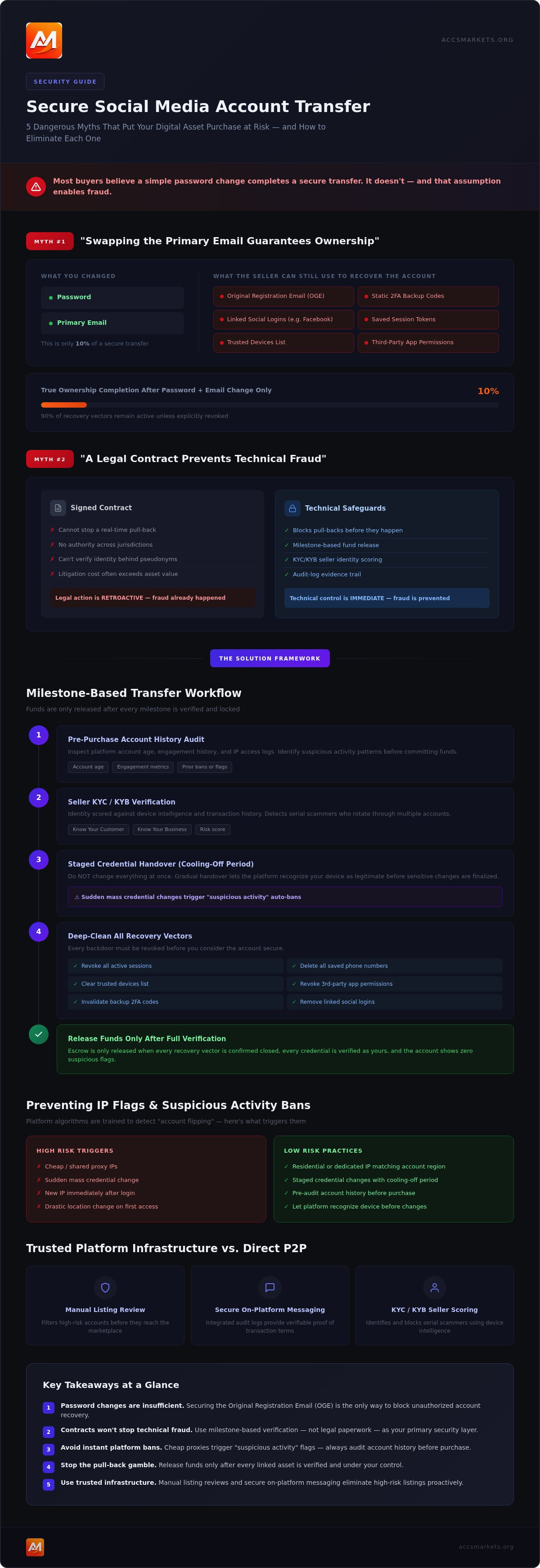
- Password changes are insufficient. Learn why securing the original registration email (OGE) is the only way to block unauthorized account recovery.
- Contracts won't stop technical fraud. Shift your strategy to a secure social media account transfer using milestone-based verification instead of legal paperwork.
- Avoid instant platform bans. Discover why cheap proxies trigger "suspicious activity" flags and how to audit account history before you commit to a purchase.
- Stop the "pull-back" gamble. Implement a staged workflow that ensures funds are only released after every linked asset is verified and under your control.
- Use trusted infrastructure. Leverage manual listing reviews and secure on-platform messaging to vet sellers and eliminate high-risk listings.
Table of Contents
Myth #1: Swapping the Primary Email Guarantees Ownership
Updating the primary email on a profile feels like a victory. It isn't. In the architecture of modern social platforms, the Original Email (OGE) remains the ultimate recovery vector. Platforms prioritize the first address used to create the account because it serves as the foundation of the user's identity. If a seller retains access to the OGE, they can often initiate a "revert" request. They claim the account was hacked. The platform sees the request coming from the original registration data and grants it. You lose the account, the funds, and the time invested.
Changing the password is only the first 10% of a secure social media account transfer. True ownership requires the total removal of all legacy recovery vectors. This includes session tokens, linked devices, and third-party app permissions that allow "silent" re-entry. If you don't strip these away, the previous owner still has a backdoor. A secure transfer is the total removal of these legacy links, ensuring no ghost of the previous owner remains.
The Danger of Legacy Recovery Links
Buyers frequently overlook hidden security layers. Backup codes are a common oversight. These are static codes generated for two-factor authentication (2FA). If the seller has these saved, they can bypass your new 2FA settings instantly. You also need to check for linked social logins. If an Instagram account is still authorized via a seller's personal Facebook profile, a password change won't stop them from logging back in. Perform a deep-clean. Revoke all active sessions. Delete every saved phone number. Clear the "trusted devices" list entirely. If it's linked, it's a risk.
Why 'Instant' Transfers are High-Risk
Speed is your enemy during a handover. Platform algorithms are trained to detect "account flipping." A sudden, drastic change in credentials followed by a login from a new IP address triggers an automated lock. It's a "suspicious activity" flag that often leads to a permanent ban. Don't change everything at once. Use a "cooling-off" period. A staged handover allows the platform to recognize your device as legitimate before you finalize the most sensitive security changes. This methodical approach is the only way to ensure the account remains active and healthy after the purchase. Patience protects your investment.
Myth #2: A Legal Contract is Enough to Prevent Technical Fraud
A signed PDF provides a false sense of security. While a contract establishes legal intent, it lacks the power to stop a technical "pull-back" in real time. If a seller decides to reclaim an account using recovery codes, your contract won't prevent the platform from granting them access. You're left with a legal document and an empty profile. This is why a secure social media account transfer must rely on technical safeguards first and legal ones second. Technical control is immediate. Legal action is retroactive.
The jurisdictional nightmare makes legal recourse nearly impossible for most buyers. If your seller is located in a different country, local courts have no authority. The cost of international litigation often exceeds the value of the digital asset itself. Scammers know this. They rely on the fact that you won't spend thousands of dollars on lawyers to recover a hundreds-dollar account. You need a system that prevents fraud before the money changes hands, not a document that promises to punish it later.
The Limitation of Paper Agreements
Identifying the person behind a screen is the first hurdle. Many digital entrepreneurs operate under pseudonyms or through shell entities. A contract is only as good as your ability to serve a subpoena. Instead of relying on paper, focus on evidence trails. Secure messaging systems with integrated audit logs provide immediate, verifiable proof of a transaction's terms. These logs are far more effective in a platform dispute than a generic legal template. Link your legal intent to technical milestones. Don't release funds until every recovery vector is closed.
Identity and Risk Scoring
Accountability requires more than a signature. KYC (Know Your Customer) and KYB (Know Your Business) integrations add a layer of protection that contracts simply lack. These systems score sellers based on their history and device intelligence. This identifies "serial scammers" who rotate through accounts. You can significantly reduce your exposure by using a platform with a manual Listing Review process. This first line of defense filters out high-risk assets before they ever reach the marketplace. It's a proactive approach to a secure social media account transfer that paper agreements can't replicate. If you want to ensure a safe transaction, verify the seller's reputation through trusted marketplace infrastructure before starting the handover.
The 2026 Framework for a Secure Social Media Account Transfer
A secure social media account transfer is not a single event; it's a technical staged workflow. Most failed acquisitions happen because the buyer treats the handover like a retail purchase. They send money and hope for the best. In a professional environment, hope is not a security protocol. You need a structured framework that eliminates human error and technical loopholes. This five-step process moves the transaction from a high-stakes gamble to a controlled, predictable exchange where every recovery vector is systematically closed.
- Step 1: Pre-transfer audit. Verify ownership evidence and audit the account's health. Check for shadowbans or engagement anomalies before committing capital.
- Step 2: Milestone-based fund securing. Move payment into a protected environment through an approved provider. Funds should be held until specific technical criteria are met.
- Step 3: Staged credential handover. Don't change everything at once. Secure the registration email first, followed by the password, and finally the 2FA recovery codes.
- Step 4: Verification period. Monitor the account for 24 to 48 hours. This "cooling-off" window ensures no legacy recovery links remain active and the platform recognizes your device.
- Step 5: Final release. Release the funds only after total technical control is confirmed and your audit log is archived for future protection.
Milestone-Based Transaction Protection
Direct "friends and family" payments are a gift to scammers. Once the money is sent, you have zero leverage. Milestone-based protection changes the dynamic. Your capital is secured by a neutral infrastructure layer and only released when specific transfer criteria are verified. The release trigger isn't a feeling; it's the confirmed change of the primary recovery email and the removal of the seller's devices. This model ensures that the seller is motivated to complete the technical handover correctly. It's about accountability, not trust. We support modern settlement options including USDT, BTC, and ETH to ensure the process remains fast and secure.
Documentation and Dispute Support
If a dispute arises, screenshots of a third-party chat app won't save you. You need a centralized record of the entire handover process. Using secure on-platform messaging creates an immutable audit log that can be used for manual review by experts. This evidence trail is your primary defense against fraudulent "pull-back" claims. When choosing where to conduct your deal, prioritize platforms that offer robust dispute support and manual listing reviews. A platform that acts as a digital guardian ensures that every instruction and confirmation is documented for your protection. This technical evidence is far more valuable than a legal contract in the immediate aftermath of a failed transfer.
Preventing IP Flags and 'Suspicious Activity' Bans
A password change doesn't hide your location. If you log in from a new country when the account was recently active thousands of miles away, you trigger an instant security lockdown. Platforms interpret these geographic jumps as a breach. This often results in a permanent ban that no appeal can fix. A secure social media account transfer requires you to respect the platform's security logic regarding location history. You aren't just moving data; you're moving a digital identity that has an established "home" in the eyes of the algorithm.
Many buyers fall for the "Proxy Everything" myth. They use cheap VPNs or shared proxies to mask their identity. This actually increases your risk profile. Most public VPN IPs are already blacklisted by major social networks for bot activity. You aren't hiding; you're flagging yourself as a high-risk user. Use dedicated residential IPs that match the seller's region if a long-distance transfer is unavoidable. This mimics organic user behavior rather than a forced takeover. It's about blending in, not standing out.
IP addresses are only part of the puzzle. Platforms use device fingerprinting to see your browser version, screen resolution, and operating system. If these change simultaneously with a location jump, the "suspicious activity" flag is inevitable. You need a "warm-up" phase. Don't post content or change sensitive settings for the first 72 hours. Let the account settle on your device before you assert full control. Patience prevents the automated systems from terminating your investment before you've even started.
Device Intelligence and Transfer Safety
Matching the seller's environment is critical during the initial handover. If possible, use the same browser type and operating system the seller utilized. Never change the "Primary Location" or "Home City" settings in the first few days. Doing so is a high-signal indicator of a sold account. You also risk "ghosting," where the account remains active but the platform suppresses your reach to zero. Stability is the priority. This controlled transition ensures the platform views the change as a legitimate user update rather than a fraudulent hijack.
Safe Acquisition of Specific Assets
Different platforms have unique vulnerabilities. When looking for monetized TikTok accounts for sale, pay close attention to the region of the Creator Fund. Changing this can permanently disable monetization. For a Facebook page marketplace transfer, manage the transition between Admin and Ownership roles carefully. Add yourself as an Editor first, then wait several days before removing the original owner. This gradual shift prevents the "unusual activity" locks common in high-value page transfers. If you want to avoid these technical pitfalls, browse our vetted social media account listings to start your acquisition on a secure foundation.
AccsMarkets: Trusted Infrastructure for Account Transactions
AccsMarkets isn't a forum; it's a trust-first infrastructure layer. Most P2P deals fail because they lack a neutral intermediary to enforce technical standards. We provide the framework required for a secure social media account transfer by automating the oversight that individuals often ignore. Every listing undergoes a manual review for ownership evidence and analytics disclosure. This first line of defense ensures that fraudulent assets never reach the market. You don't have to guess if a seller is legitimate. Our integrated KYC and KYB risk scoring provides a layer of accountability that a simple direct message cannot match.
Transaction protection is coordinated with approved payment providers to secure funds until milestones are met. We support modern settlement options including USDT, BTC, and ETH to ensure speed and security. If a dispute occurs, our team conducts an evidence-based review using secure on-platform messaging logs. We don't rely on hearsay. We rely on documented outcomes. This methodical approach eliminates the anxiety of high-stakes digital acquisitions. It is a controlled, monitored environment designed for professional safety.
Why Professional Operators Choose AccsMarkets
Professional operators require precision. When listing a Telegram channel for sale, sellers use structured tools to disclose growth metrics and audience data. Our manual review queues verify this information before the listing goes live. This "Trust-First" philosophy reduces the risk of buying inflated or botted channels. It protects the buyer's capital and the seller's reputation. Efficiency meets transactional integrity. There is no space for marketing fluff, only verifiable data.
Getting Started with a Secure Transfer
Safely acquiring an asset starts with the right filters. If you want to buy monetized YouTube channel assets, our platform allows you to screen for specific niche and revenue data. Once you find a match, use the AccsMarkets dashboard to track each transfer milestone in real time. Set your negotiation parameters within our secure messaging system. This keeps all communication within a monitored environment. Follow the prompts. Verify the assets. Close the deal with the confidence that every technical recovery vector is closed. Your peace of mind is our priority.
Mastering the Digital Handover
Digital assets represent significant capital. Protecting that capital requires more than a handshake or a PDF. You now understand that a secure social media account transfer is a technical process, not a legal one. It requires stripping away legacy recovery vectors and respecting platform security algorithms during the transition. Blind trust is a risk you don't need to take. Professionals prioritize verification over promises.
Move your transactions into a controlled, monitored environment. AccsMarkets provides the infrastructure for Clear Listings, Safer Workflows, and Better Accountability. Every listing undergoes Manual Listing Review & Verification to ensure you're buying legitimate assets. With Milestone-Based Transaction Protection, your funds remain secure until every technical handover step is complete. Secure your next digital asset on AccsMarkets and scale your online presence with peace of mind.
Frequently Asked Questions
Is it legal to transfer a social media account in 2026?
Account transfers are legal under private contract law, but they usually conflict with a platform's Terms of Service. This conflict is a civil issue, not a criminal one. No specific laws prohibit the sale of digital property, but platforms can terminate accounts if they detect a change in ownership. You must focus on technical stealth to ensure the platform views your login as a legitimate continuation of the original user's activity.
What happens if the seller tries to recover the account after I pay?
When using milestone-based transaction protection, your funds are secured until you verify the removal of all legacy recovery vectors. If a seller attempts a "pull-back" during the verification period, you can freeze the payment. To stop recovery after the deal closes, you must control the Original Email (OGE). Without it, the seller can use automated support tools to claim the account was stolen and bypass your security.
How long does a secure social media account transfer usually take?
A secure social media account transfer generally requires 48 to 72 hours to complete safely. While the actual password swap is instant, the "cooling-off" period prevents automated platform locks. This window allows you to audit the security settings and ensure no hidden recovery links remain active. Moving too fast often triggers "suspicious activity" flags that lead to permanent bans. Patience is the primary defense for your investment.
Can I use PayPal for social media account transfers?
PayPal is not recommended for digital asset deals because its protection for "intangible goods" is notoriously inconsistent. Sellers face the risk of fraudulent chargebacks, while buyers have no way to verify the technical handover through the payment platform. Professionals use settlement options like USDT or BTC coordinated with milestone-based protection. This ensures that capital only moves after specific technical criteria, such as OGE transfer, are fully met and verified.
What is an 'OGE' and why is it so important for security?
OGE stands for "Original Email," which is the address used to create the account. It serves as the foundation of the account's identity and the primary recovery tool for platform support. Securing the OGE is the most critical step in a secure social media account transfer. If the seller keeps this email, they can reclaim the account at any time. Controlling the OGE effectively closes the most common backdoor used by scammers.
How do I avoid getting my new account shadowbanned during the transfer?
Shadowbans occur when platform algorithms detect bot-like behavior or a sudden change in ownership. To avoid this, don't change the account's niche or delete old content immediately. Maintain the previous owner's posting rhythm for at least one week. Using a dedicated residential IP that matches the account's historical location also helps. These steps ensure the platform sees a seamless transition rather than a high-risk takeover that requires reach suppression.
What evidence do I need to win a dispute if a transfer fails?
Successful disputes rely on immutable evidence from a secure messaging system. You must provide screenshots of the credential exchange and the removal of the seller's recovery phone numbers. If a "pull-back" occurs, document the platform's notification of a recovery request. These technical logs prove that the seller breached the transaction milestones. Marketplaces use these audit trails to determine fault and return funds to the buyer when a technical fraud is confirmed.

Frequently asked questions
Is it legal to transfer a social media account in 2026?+
Account transfers are legal under private contract law, but they usually conflict with a platform's Terms of Service. This conflict is a civil issue, not a criminal one. No specific laws prohibit the sale of digital property, but platforms can terminate accounts if they detect a change in ownership. You must focus on technical stealth to ensure the platform views your login as a legitimate continuation of the original user's activity.
What happens if the seller tries to recover the account after I pay?+
When using milestone-based transaction protection, your funds are secured until you verify the removal of all legacy recovery vectors. If a seller attempts a "pull-back" during the verification period, you can freeze the payment. To stop recovery after the deal closes, you must control the Original Email (OGE). Without it, the seller can use automated support tools to claim the account was stolen and bypass your security.
How long does a secure social media account transfer usually take?+
A secure social media account transfer generally requires 48 to 72 hours to complete safely. While the actual password swap is instant, the "cooling-off" period prevents automated platform locks. This window allows you to audit the security settings and ensure no hidden recovery links remain active. Moving too fast often triggers "suspicious activity" flags that lead to permanent bans. Patience is the primary defense for your investment.
Can I use PayPal for social media account transfers?+
PayPal is not recommended for digital asset deals because its protection for "intangible goods" is notoriously inconsistent. Sellers face the risk of fraudulent chargebacks, while buyers have no way to verify the technical handover through the payment platform. Professionals use settlement options like USDT or BTC coordinated with milestone-based protection. This ensures that capital only moves after specific technical criteria, such as OGE transfer, are fully met and verified.
What is an 'OGE' and why is it so important for security?+
OGE stands for "Original Email," which is the address used to create the account. It serves as the foundation of the account's identity and the primary recovery tool for platform support. Securing the OGE is the most critical step in a secure social media account transfer. If the seller keeps this email, they can reclaim the account at any time. Controlling the OGE effectively closes the most common backdoor used by scammers.
How do I avoid getting my new account shadowbanned during the transfer?+
Shadowbans occur when platform algorithms detect bot-like behavior or a sudden change in ownership. To avoid this, don't change the account's niche or delete old content immediately. Maintain the previous owner's posting rhythm for at least one week. Using a dedicated residential IP that matches the account's historical location also helps. These steps ensure the platform sees a seamless transition rather than a high-risk takeover that requires reach suppression.
What evidence do I need to win a dispute if a transfer fails?+
Successful disputes rely on immutable evidence from a secure messaging system. You must provide screenshots of the credential exchange and the removal of the seller's recovery phone numbers. If a "pull-back" occurs, document the platform's notification of a recovery request. These technical logs prove that the seller breached the transaction milestones. Marketplaces use these audit trails to determine fault and return funds to the buyer when a technical fraud is confirmed.
Ready to buy or sell an account?
Browse verified listings, protected by escrow.


